What survives when the platform changes.
Every site depends on services that could change, fail, or be acquired. The question isn’t whether your stack has dependencies — it’s which ones are swappable, and which ones aren’t.
In June 2023, Squarespace announced it had acquired Google Domains. Customers who had registered domains with Google — small businesses, nonprofits, individual practitioners — got an email. They had not asked for this. The migration to Squarespace’s registrar was scheduled, the timeline was fixed, and the question of whether was already decided.
For most, the move was uneventful. For some, it wasn’t. Domain transfers across registrars are a known process, but they aren’t always clean — DNS records translate imperfectly, email-forwarding rules don’t always survive the move, contact information gets revalidated against new policies. People who had set their domain up years earlier and not touched it found themselves clicking through migration prompts they didn’t fully understand.
None of them had done anything wrong. They had registered a domain at a major vendor and expected it to stay where they put it. They were right to expect that. They just got an email saying it wouldn’t.
— When the floor moves
This isn’t a one-off.
Posterous shut down in 2013, a year after being acquired by Twitter. Users got three months’ notice and an export tool. Most of what was exported, on most blogs, came across with broken images and stripped formatting.
Tumblr changed its content rules in 2018 and removed an entire category of accounts overnight. Whether you agreed with the policy is beside the point — accounts that had operated under the old rules for years were not grandfathered in.
In 2019, MySpace admitted that twelve years of user-uploaded music had been lost during a server migration. Lost. The platform was still running. The accounts were still there. The content was gone.
The pattern: every platform offers an implicit deal — you bring your work, we provide the infrastructure to host it. The deal is honest enough at signup. What isn’t always clear is that the platform reserves the right to redefine the terms. Acquisitions, policy changes, cost cuts, technical migrations — every one of these is a unilateral move, and every one of these has happened.
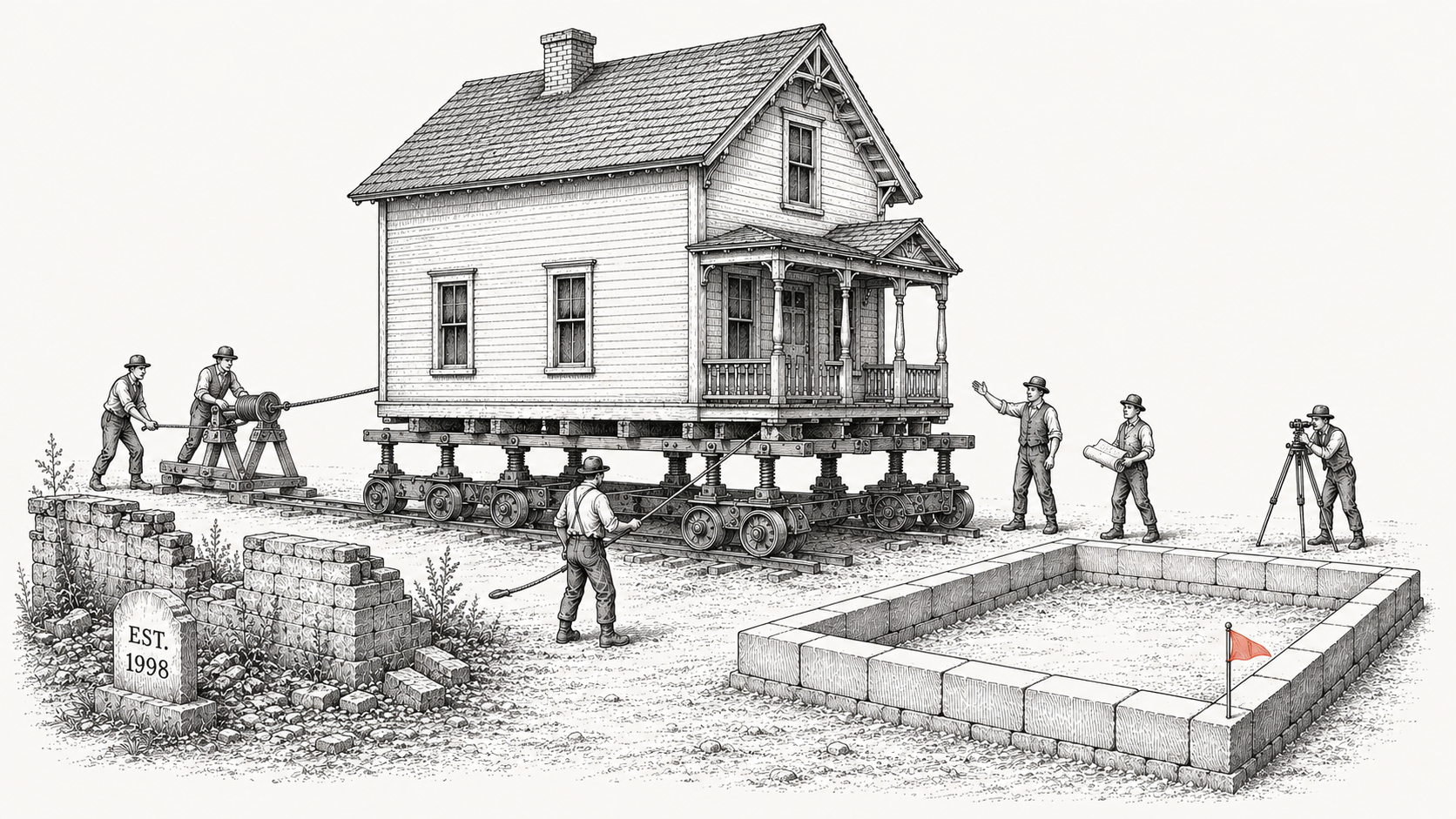
The structure is yours. The foundation is replaceable.
— What you actually have
So here’s the harder question, and it’s one I have to answer honestly: doesn’t this apply to me too?
It does. Sevra builds run on Netlify. Netlify is a platform. Netlify could be acquired tomorrow. Netlify could change its pricing or pivot its product. I don’t have any more control over Netlify’s future than a Squarespace customer has over Squarespace’s.
The difference isn’t that Sevra builds escape platform dependencies. Every site has a host. The difference is what’s left when the host changes.
A Sevra build is a folder of static files — HTML, CSS, JavaScript, images. Those files run on Netlify because that’s where I deploy them. They also run on Cloudflare Pages. They run on GitHub Pages. They run on any static host with a drag-and-drop deploy or a connect-to-Git workflow. If Netlify wound down tomorrow, the migration would take half a day: download the files, point the domain at a new host, redeploy. No rebuild. No data loss. No content stuck in someone else’s database.
A Squarespace site doesn’t have that property. A Squarespace site only runs on Squarespace. The site doesn’t exist outside of Squarespace’s database in any form you can take with you. The export tool gives you a partial archive — text and images, mostly, with some formatting — and not a working site.
That’s the difference. Not no dependencies. Swappable dependencies.
The domain is in your name at your registrar. The hosting account is in your name at Netlify. The files are static and portable. None of this means nothing can fail. It means failure is a layer you can swap, not a layer that takes the whole site with it.
— A test you can run
Here’s the test, and it’s a variation on the walk-away test from the first note in this series. That one asked what would still be running if you stopped paying everyone tomorrow. This one asks something narrower:
If your host announced tomorrow that they were winding down in 90 days, what would you do?
If the answer is I’d download my files and redeploy somewhere else — same site, same domain, half a day of work — your dependencies are swappable. You’re fine.
If the answer is I don’t know, my site only exists on this platform — you don’t have a site, exactly. You have a tenancy. The distinction usually doesn’t matter, until the day it does.
The whole point of I build, you own is that what you own isn’t theoretical. It’s the structure. The foundation underneath can change. The structure moves.