Built in, not bolted on.
Most people who use the phrase “SEO” mean something hazy. Pull it apart and there are five different disciplines underneath — and four of them are decisions made at build time.
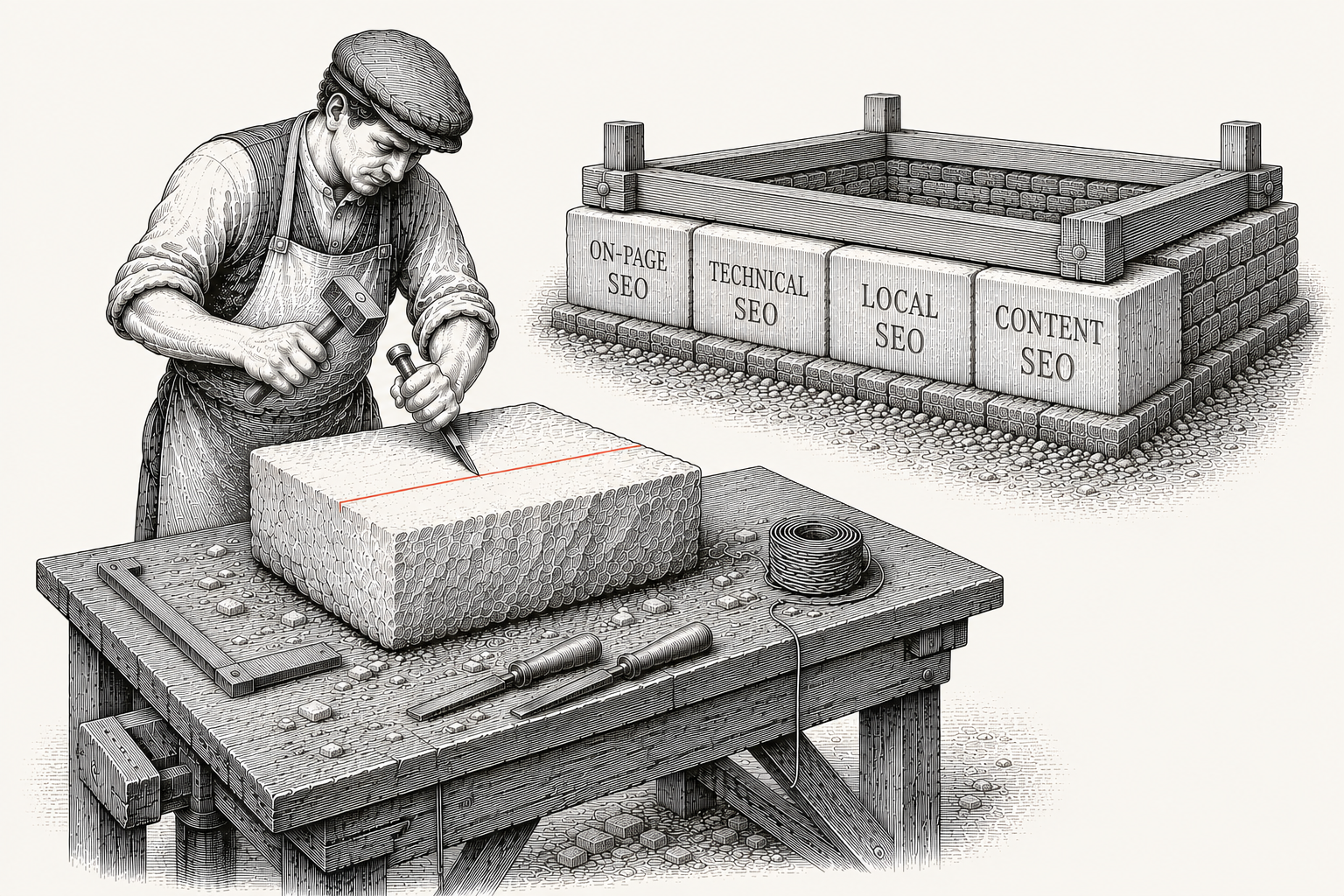
Search engine optimization — SEO — does the same work “marketing” or “branding” does: it sounds like one thing, and it isn’t. Underneath are five different disciplines, with five different price points and five different sets of practitioners. Some of it is genuinely valuable. Some of it is sold as valuable when it isn’t. And a lot of it is already done — or not done — the moment your site goes live.
The five parts are worth knowing, if only so you know what you’re paying for the next time someone offers to “do your SEO.”
— The five parts
1. On-page SEO is the structure inside each page. The title that shows in browser tabs, the meta description that appears under your link in search results, the headings that organize the page, the alt text on images, the URL structure. It tells search engines what each page is about.
2. Technical SEO is the plumbing beneath the site. The sitemap that lists your indexable pages, the file that tells search engines where to look and where not to look, the structured data that turns a page into a record search engines can read like a database row, the security headers and HTTPS that mark the site as safe, the mobile responsiveness that affects ranking directly. Page speed lives here too.
3. Local SEO is everything tied to a place. Google Business Profile, Yelp, Apple Maps, Bing Places, the BBB — the directory presence that tells search engines your business is real and where it’s located. It also covers reviews, photos, and the consistency of your name, address, and phone number across every place they appear.
4. Content SEO is the slow one. Writing pages that genuinely answer questions people search for. A landing page, a guide, a series of articles — anything that earns its place in search results because it deserves to be there. It compounds over years, not weeks.
5. Off-page SEO is the hardest. Other sites linking to yours. A link from another reputable site counts as a small vote that yours is credible. The more votes, the higher the ranking — but not all votes count equally, and many are easily faked. This is the bucket where most “SEO services” make their living, and it’s the bucket where the work most often turns out to be either useless or, on the bad end, actively damaging.
SEO has five parts. We ship four of them with the site.
— What we ship with the site
Of the five, four are decisions made at build time. Either the site has them or it doesn’t.
Every site we build ships with on-page SEO as a default — titles, meta descriptions, headings written for both humans and search engines, alt text on every image, semantic HTML structure that tells assistive technology and search engines what each section is. Part of that work happens with you: during the build we work out the terms your customers actually search for, so the titles, descriptions, and headings are written around the words that matter. The technical layer ships too: sitemap, robots file, structured data declaring your business as a real entity that can be read like a record, link-preview tags so the site previews correctly when shared, canonical URLs, security headers, HTTPS, and a Lighthouse score above 90 on accessibility, performance, SEO, and best practices.
We also help set up the local layer at handoff. Google Business Profile, the citation surfaces that make your business findable on Maps, Yelp, Apple, the BBB. Once those are in your name and consistent with your site, they stay productive without much intervention.
Content SEO is part of the build for clients who want it. A few pages written to address what your prospects search for — service pages, location pages, an FAQ — is the difference between a site that exists and a site that earns visibility. We write it during the project; you maintain it afterward.
None of this is sold separately. It’s not a premium add-on or a “Pro” tier. It’s part of what a website is supposed to be, and skipping it is what makes most templated sites underperform. It’s just usually invisible — which is why platform builders and amateur sites can get away with shipping without it.
— What’s still yours to grow
The fifth bucket — off-page SEO — is where ongoing work happens. Backlinks accumulate over time as people find your site, write about it, link to it from theirs. Reviews accumulate as you do work that earns them. Citations expand as you join your local chamber, your trade association, your regional directory.
Some of this is your work. Some of it is work you can hire out. A good local SEO can earn their fee through citation management, content writing, and real outreach to publications. A bad one will charge you for automated tools running in the background and call it “optimization.”
If you ever consider hiring help here, the questions to ask are simple. What do you do, specifically. Can you show me last month’s deliverables for a current client. Can you show me a screenshot of their Search Console data over time. A good one will have ready answers to all three.
What ships with the site is what we can guarantee. What grows from there is the part that needs your attention — or someone you trust to give it that attention. The foundation is already laid.